Monday, May 15, 2006

Dorodango


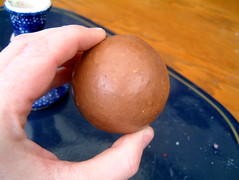
My first dorodango

This is my first, very poor attempt at making a dorodango. It's not supposed to look this rough (I used soil that was too gritty), but I was still very impressed that it worked at all. You can't tell from the photo, but the ball is rock-hard and heavy. It looks exactly as if I found a nearly perfectly round rock and gave it several coats of enamel. I only dimly remembered reading about the Japanese art of making these things (I read the linked Web page a year ago), but while watching my son play baseball it occurred to me that the soil at baseball fields, with its mixture of sand and clay, would probably be perfect for making one. I just threw some water on the soil, formed a ball, and started polishing using dry soil. This is the result after a hour and a half or so. It would have come out smooth if I had sifted out the pebbles, which I may try next time.

Friday, May 12, 2006

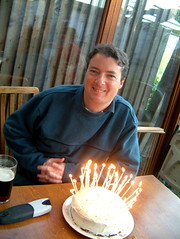
Another year


DSCF0002.JPG
Originally uploaded by ailishsul.

The beer, the TV remote control and lots of candles on the cake... The parallels with Homer Simpson are becoming scary.

Wednesday, May 10, 2006

Roman Holiday


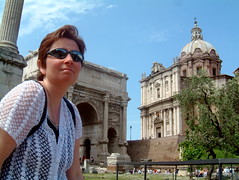
Theresa looking out over the forum
Originally uploaded by Eamonn_Sullivan.

Theresa and I are back from a short trip to Rome, our first. The city wasn't high on my list of places to see. Iceland was considerably higher, to give you an idea. But I thoroughly enjoyed it.

As usual, I set out to learn the language before we went and didn't get far. My excuse this time was that my iPod died -- complete hard drive failure. That happened about three days into my attempt to get through an Italian audio course and it meant I had to listen to it in the car (30 minutes a month, approximately) instead of the tube (2.5 hours a day). I ended up barely knowing how to say non parlo italiano by the time we arrived.

We saw the usual sights -- Vatican, Coloseum, the Roman Forum (that's the Arch of Septimius Severus behind Theresa). We walked about 10 miles on the first day, so had to take a break on the second and hang around a huge public park near the hotel, filled with local families and some sort of African festival. We ended the day at a wonderful little trattoria (family restaurant) in an alley in the Trastevere neighborhood.

On the third (and final) day, we spent most of it in at the Vatican museum and St. Peter's. The museum was fabulous, but the crowd going to see the Sistine Chapel wasn't so fab. We felt like cows being herded. We quickly broke off and made our way to the quieter exhibits. For lunch, we ate at a pizzeria recommended by a colleague at work. We ended the evening at a more upscale restaurant near our hotel for a complete, six-course meal. It was wonderful, but I feel like I brought some of Rome home with me, around my middle...

The complete set of photos from the trip is here.

Tuesday, April 18, 2006

Quiet

I read an essay a few months ago in which the writer advocated spending a day alone, once a year, with no distractions but your own thoughts. It sounds attractive, especially after the past few, non-stop months, but for me it would be like forcing a couch potato run the marathon. I'd be in no better shape afterward, assuming I survived.

A more fruitful approach is to integrate quiet time into daily life, like regular exercise. My first encounter with that idea was the Rule of St. Benedict, a guide for monastic life written in the sixth century. I became familiar with it while attending Saint Anselm College in New Hampshire, which is run by Benedictine monks.

You don't have to be religious to appreciate the central theme of the Rule: balance. The monks' days are divide into manual labor, quiet contemplation, socializing and service to others. The balance still fits well, even after 800 years. Labor was set at about six hours a day, which is bang on for productive work, in my experience. Sufficient food and sleep was considered important and the rule has little of the gratuitous austerities then fashionable. It was written for real human beings, exhorts them to be human, and it's still going strong.

Alas, modern life often isn't very amenable to balance. I may only be truly productive for six or seven hours a day, but my bosses don't want to hear that. So I'm in the office, typically 11 or 12 hours a day, eating both breakfast and lunch at my desk. Couple that with about 2 1/2 hours commuting, seven hours or so of sleeping, and that leaves about two hours a day to accomplish everything else.

That doesn't mean I can't integrate quiet time in my life, of course, but it does mean I have to make trade-offs that are difficult. I already spend too little time with my family and don't exercise enough, for example. I'm also an insatiable student. I've spent many hours of that free time this year learning Common Lisp, just for the heck of it. So, what goes? And when? It's an ongoing struggle.

Another approach is to make whatever I'm doing a quiet meditation. This idea is a heck of a lot older than the Rule of St. Benedict, stretching back at least to Buddhism. Basically, it's the belief that life is what is happening right now and that most of us wander through existence in a dream-like state, worrying about the future, dwelling on the past or feeling deprived of some imagined need, such as money or time. Those who reach enlightenment, Buddhists say, are fully present, fully aware of life, and at peace.

That idea is behind the "mindfulness" approach that has taken off lately. See here, for just a very recent example. And it's no wonder. "Continuous partial attention" is the norm today. We're always doing several things at once, while planning our next steps and worrying about the previous one.

Escaping from this is so hard that people try to find easy short cuts. One is extreme sports, which force you to be fully here, fully focused on the present moment, more alive. But thrill-seeking is a cheap, shallow copy of what an enlightened, mindful Zen Master can accomplish while washing the dishes, sweeping the floor or simply sitting under a tree. What the parachutist accomplishes is more basic -- a survival mode, an adrenalin-fueled rush. What the mindful can accomplish, even while skydiving, is to be fully human.

Learning to quiet that constant, inane chatter in our heads takes practice, however. And fighting it doesn't work. Try telling yourself to think of nothing... The way Zen Masters do it is to develop a level of detachment, so they can observe themselves wandering and gently bring their minds back.

Although gaining that skill takes a lifetime -- or several, according to Buddhists -- even the first faltering steps are worthwhile. Just yesterday, I was dwelling on all of the things that are hanging over my head, such as the big news events coming up at work that I must prepare for, the seemingly endless list of repairs needed on the house and the worries about my wife and children. And then I looked up and paid attention to what was happening around me. I was walking the dog, with my beautiful wife, on a gorgeous, sunny day. The birds were singing, the blossoms blooming and the only thing that needed doing, right now, was to be here and enjoy the walk.

Even in my busiest, most hectic moments, the contrast between my harried mind and the what is actually happening is stark. I may be jamming under a very tight deadline, with multiple people demanding my attention at once, but the present moment consists of making the sentence under my cursor read well, with no errors or awkward phrases. The present moment is always quiet, always peaceful.

I'd like to try a day of silence sometime, maybe 24 hours on a shoreline with a pup tent and a sleeping bag. But I suspect it wouldn't improve my life as much as the essay writer thinks. A better approach would be to just pay attention to the quiet around me. Right now.


Tags:

Saturday, April 08, 2006

Sunday, January 29, 2006

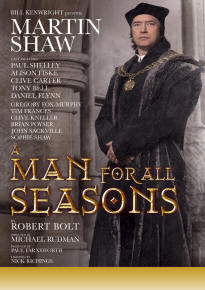
A Man for All Seasons

We went to see A Man for All Seasons with Martin Shaw last night with my parents, who are visiting from the U.S. It was excellent. I only dimly remember the film and never saw it on stage before, but my father watched the play in the early 1960s, with Paul Scofield, and he enjoyed this production as well. If you get a chance, catch it before it closes on April 1st.

My favorite part of the play is when More defends the law against the ultimate in "the end justifies the means" arguments. The character Roper and More's daughter Alice beseech More to have his eventual betrayer arrested before he leaves the house, even if he has to make up some pretext. More argues that doing that would be a very bad idea:

Alice: While you talk, he's gone!

More: And go he should, if he was the Devil himself, until he broke the law!

Roper: So now you'd give the Devil benefit of law!

More: Yes. What would you do? Cut a great road through the law to get after the Devil?

Roper: I'd cut down every law in England to do that!

More: Oh? And when the last law was down, and the Devil turned round on you - where would you hide, Roper, the laws all being flat? This country's planted thick with laws from coast to coast - man's laws, not God's - and if you cut them down - and you're just the man to do it - d'you really think you could stand upright in the winds that would blow then? Yes, I'd give the Devil benefit of law, for my own safety's sake.

Roper's sentiment is as strong as ever. Terrorism, or whatever the evil du jour, may seem to justify sweeping away inconvenient laws, as long as it makes us safer. But it has the opposite effect in the long run.


Tags: ,

Sunday, January 22, 2006

Programming and Writing

I was speaking to a fellow editor recently and confessed my secret: I program computers for fun.

"Are you sure you're in the right job," she asks.

Yes, I reply, because programming and writing, especially non-fiction writing, are essentially identical skills. I believe that's why there are many good programmers who are also good writers -- Paul Graham, just to take one example. That we don't see too many examples of the reverse is because few writers understand the symmetry.

Both aim to convey information -- ideas, images, numbers and text -- in the most concise and efficient way possible. And both achieve beauty when they succeed. I wouldn't compare programming to Shakespeare, but there's not much separating a good software application from a well-written news story or essay. Software conveys information to a computer initially, while the written word is read directly by a human reader. But even that difference is just a distraction. The ultimate target of both is a person.

I've written for a living and programmed for fun for at least 20 years now and find that practice in one improves the other. Neither can be done well unless I'm thinking very clearly about the problem I'm trying to solve or the ideas I want to convey. Building logically from one point to another, in the simplest, clearest way possible makes good source code and good writing.

And just as learning different human languages can make you a better writer, learning other computer languages makes you a better programmer. I'm absolutely hopeless at learning human languages, and struggle enough with English to keep me well occupied. I studied French for years and still can't ask for directions or understand the answer. I don't remember much about the Latin I studied in High School, nor the Russian I spent two years wrestling with at university, but I do believe I've received benefits from them. I may not remember many specifics, but I do remember the ideas, recognize a Latin root or two and have observed the pluses and minuses of their different approaches. A phonetic alphabet (Russian) is a good thing, for example, as is precision in the choice of words.

I can't claim to be any better at computer languages, but at least I pick them up faster. I've programmed in Basic, Pascal, Fortran, C, C++, Java, Perl, Visual Basic and lots of different application-specific macro languages. My current favorite is Python, and I've written fairly complex graphical programs in it. As with the human languages, I've absorbed them to varying degrees. I can still pick up a Basic program, even though I haven't programmed in the language in any serious way since the Apple IIe, while I would have to learn C++ and Java again from scratch. And, again, I've benefitted from each, because each has a unique way of approaching and solving problems.

Since the beginning of the year I've also been putting in some serious effort into learning Common Lisp, so I'll use that to illustrate some of the benefits.

Lisp has been compared to Latin. In computer terms, it's certainly as old as Latin, dating back to the mid 1950s. But I think it's closer to a language with a completely different alphabet or wholly unfamiliar grammar, like Greek, Japanese or Hebrew. Unlike most modern languages, which are based on a predecessor known as Algol, Lisp isn't written in a way that would look familiar to most people.

The Pythagorean Theorem --

c = √(a²+b²)

-- might be written in a Algol-derived language such as Python, like this:


c = sqrt(a**2 + b**2)

Most people would find that at least familiar, once told that sqrt means square root and ** means exponent, anyway.

In Lisp, however, one way to write the same thing might be:

(setf c (sqrt (+ (* a a) (* b b))))

The inside-out style is definitely unfamiliar, but it doesn't take too many bouts with really hairy algebra or tricky text manipulation to understand that it is more efficient for some problems. There are many tasks that would take several steps in an Algol language, but can be solved with a tight one-liner in Lisp that, once you get used to it, is still readable. Learning a new language, in other words, is forcing me to think differently, out of the box.

Another benefit of putting effort into both disciplines is that it puts you in charge of two essentials of the modern world: communications and computers. The latter is getting as ubiquitous and as necessary as the former. Just as illiteracy can turn a free human being into a slave, computer ignorance will make you steadily less and less in control of your life in the next decades. Kids today are being taught nothing about computers in school except how to run Word and Excel. Who's the master in that relationship? It isn't the student. Programming has made me as confident in wielding a computer as the written word. (Read: not very, but I'm learning.)

The original question -- about whether I'm sure I'm in the right job -- assumes a divide between the sciences and the liberal arts, math and art, computers and words. I don't think it exists. I'm proud to be interested in both.

And, anyway, it's a lot more interesting than doing a crossword puzzle.


Tags: ,

Thursday, December 29, 2005

Last three books I've read

While I'm catching up, here are the last three books I've read and enjoyed.

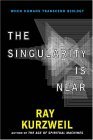
border=0Ray Kurzweil's The Singularity Is Near took me weeks to read, and not just because it is over 600 pages (including notes). What made it hard was its extraordinary ideas. Every page had an insight -- the nature of consciousness, blurring of human-computer boundaries, the nature of a "self" and the impact of computing power limited only by physics. My mind kept wandering over the implications -- I'd read a paragraph and then find myself dreaming up a Philip K. Dick novel.

Kurzweil starts with a simple premise: the rate of progress is accelerating exponentially, which he backs up with some convincing evidence that extends back at least as far as the discovery of fire and invention of stone tools. He then carries on logically and methodically to show why, if that's true, we're much closer than we realize to some extraordinary advances, when progress will essentially proceed at an infinite pace (the "Singularity"). I think he underestimates the complexity of many of these problems, but that would only delay some of dilemmas that we'll face. Just to take one example: Kurzweil compares individuals to the shape of a river, with the water representing the atoms that make up our physical bodies. Because every molecule in our bodies changes about once a month, Kurzweil argues, what we are is a pattern of information, like the shape of the river. Every neuron, and every other part of us, can theoretically be modeled in a computer. What happens when computers get powerful enough to host all of that information? Is it a person? Why not? If Kurzweil is right, we'll be confronting questions like that faster than we realize.

border=0
Alastair Reynolds's Pushing Ice was a bit of a mental break compared with Kurzweil's book, but it still had plenty of insights. This is the first book I've read by Reynolds, who has a Ph.D in astronomy and works for the European Space Agency. The story starts in the second half of this century and evolves around a comet-mining ship that is diverted to chase what appears to be an alien vessel racing away from the solar system. Like the last Ken MacLeod book I read, Reynolds takes minimal liberties with the laws of physics. That leads to a problem: Going anywhere interesting takes months or years in space, which leaves conflicts aboard ship to provide much of the action. There's plenty of that before anyone ever encounters an alien, assuming they'd recognize it as such. As time drags on and the chase turns involuntarily into a long-term, interstellar mission, the crew has to struggle to survive.

As always, the science in this fiction isn't strictly necessary. The same story could be told about a ship rounding the horn of Africa in the 16th century. But Reynolds obvious grasp of the science adds to the gripping read. Unlike Kurzweil's book, I devoured this in a couple of sittings.


border=0
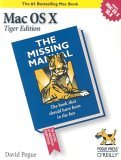
I'm only about half-way through David Pogue's Mac OS X: The Missing Manual, but it's a skimmer anyway. I'll be popping in and out of this book for quite a while since, as I've mentioned in a previous post, we got an iMac for Christmas. Although I've used Macs once in a while while working for PC Week, I haven't used one in earnest since college, when Apple's computers ran a totally different operating system. I've been pleasantly surprised on how similar OS X is to Linux (since it has a free BSD operating system underneath) and Pogue's book does a good job of filling in some of the blanks. The author's focus, however, is aimed squarely at the non-nerd, home computer user. I'm still struggling to get my head around the way OS X manages daemons and schedules tasks, which isn't something that will keep the average home user awake at night. It's something I worry about, though. It took me a week to get a daily backup working, which I finally managed by just piggy-backing on tasks that the computer already does on a daily basis. Perhaps I should try some of the other O'Reilly books on the Mac, such as the ones geared toward people who area already familiar with Unix.


Tags:

Splogspot?

I've apparently offended someone enough to be listed, next to dodgy drug sellers and loan sharks, in Splogspot' s list of spam blogs. I've not heard of this site before, and my initial impression isn't good. I used its method of appeal (a little link next to each entry that says 'not spam?'), pointing out that I would think a spam blog would have to be trying to sell something, or at least carry ads. I've heard nothing back in a few days and there isn't any other contact information on the site.

I understand that spam blogs (or splogs for short) are a big problem, but a heavy-handed black list, with little or no accountability, is a poor answer.


Tags: ,

Monday, December 26, 2005

Christmas presents

It must be a sign, but I'm not sure of what. Theresa and I ended up with the coolest gifts this year.

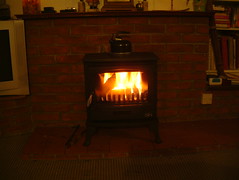
Theresa's main present was a fireplace -- our first in at about 16 years (Ailish was a baby the last time we had one). It puts out a lot of heat, easily heating most of the downstairs. And if I get carried away and stuff too much into it, we have to move upstairs or out in the sunroom for a while. (I'll eventually get my pyromania under control.)

New fireplace

What I especially like about it is that we don't watch the TV as much. It's more pleasant to just sit around the fire, listening to music or reading a book.

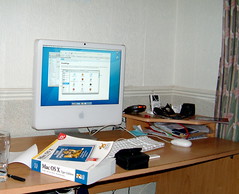
My main gift is a new 20-inch iMac. It's mostly for the kids, since I have a PC running Linux upstairs. But I get to play with it a lot, especially when I'm off a few days. (I'm writing this now on the iMac.)

My Christmas present

I've wanted a Macintosh since college, and a few days with the real thing has convinced me that Apple has the most advanced PC on the planet, by far. Windows can't touch this. (Nor can Linux, for that matter, but what do you expect for free?) Apple's decision to switch from the PowerPC processor to Intel has more recently given me pause. What tipped me over this time is that the kids' Windows PC is beginning to fall over and the thought of starting all over again with the battle to keep it upright against a determined kid attack was just too much. The Mac, like Linux, is far better equipped for life on the Internet, even (and especially) in the hands of children. Plus, the kids are now getting familiar with Windows, Linux and Mac OS X. They're able to sit down on any of them and be productive. That's got to be worth something. The Intel migration, I decided, wasn't much of a worry. A family PC has a 2-3 year life and, by then, Apple will have made the transition and it'll be time to start thinking of a new main computer.

I'm in the process of trying to get my head around Apple's version of Unix, which isn't very different from Linux. Still, it's the differences that are tripping me up. I've created a script to back up everyone's documents folder to Linux using rsync. This is native-speaking for Mac OS X, happily, except for telling it when to run (cron seems to be ignored). I've figured out that I need to use Apple's next-generation services interface via a program called launchd. It's still early days for that, however, and creating and managing services is a bit rough. You have to create an XML file and put it into a central place. I guess I thought "crontab -e" was difficult, when I first encountered it, so this will be no different. I found a good program called Lingon that made it easier to set up and schedule the tasks. I'll find out tomorrow morning if it works.

border=0


Another gift that will mostly be used by the whole family is a GPS (global positioning system) receiver. I wrote a post recently about our weekly outings to local parks and Dean Shareski added a comment suggesting we try geocaching. We're taking him up on it. The kids have already found a couple of caches nearby. The idea is that you use GPS to find containers (usually tupperware) hidden around the world. The boxes have little tidbits in them -- little momentos. You take one and add one. Sounds fun and it'll make walking Dude a little more interesting.

The kids? Well, they got the usual assortment: Nintendo DS, some Playstation 2 games (and the network adapter), and various loud toys. But I've barely noticed. I'm too busy playing.

Tags: , ,

Sunday, December 04, 2005

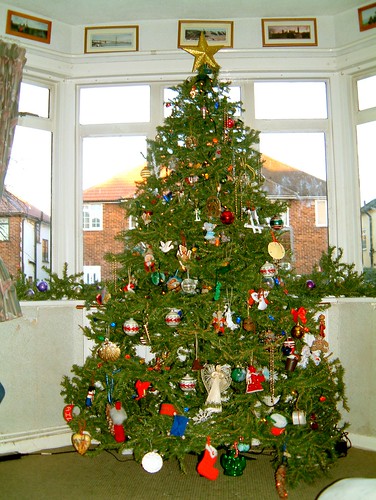
This Year's Christmas Tree

Finished tree

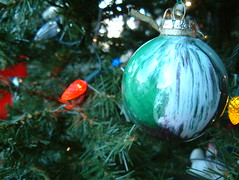
We put up our Christmas tree a little early this year, since Theresa and I will be working most weekends this month. As usual, it's virtually impossible to take a good photo of a Christmas tree. You either see the tree or the lights (and the latter fuzzily). Ailish, our family photographer, gets the right idea, as usual, snapping a photo of just one ornament:

Ornament

Now, why didn't I think of that?


Tags: ,

Sunday, November 27, 2005

Thanksgiving in London

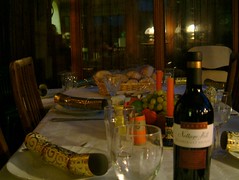
Thanksgiving setting

We're living our eighth year in London, overstaying our "two-year adventure" by quite a bit. But even though most of the kids speak with English accents and we've all grown comfortable with the British variant of the language, we still celebrate Thanksgiving every year. It is, by far, the best holiday -- a mostly non-commercial anomaly in a marketing-driven world. No gifts, no cards, just food and getting together.

This year, unusually, we celebrated on the day itself. I took Thursday and Friday off, just for the heck of it, and our guests were also available. We have to make a few adjustments -- the local "stuffing" is a lot denser, for example -- but turkeys are abundant now as we get closer to Christmas. Kathy picked us up some canned pumpkin for making into pies at a store in Hampstead that specializes in "American" food, and we can even find cranberry sauce in the shops now. Either Theresa is getting better at finding the fixings, or the English are picking up on our tastes.


Tags: , ,

Friday, November 18, 2005

How to Wake Me Up

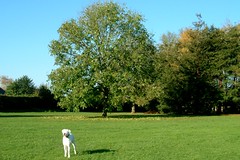
crisp day

I worked one of my rare overnight shifts, from around 5pm Thursday evening until 2:30am on Friday. One advantage of doing just one, instead of a whole week's worth, is that you end up only working four days that week. I had the day with Theresa on Thursday, with plenty of time for a long walk with the dog and then lunch at a local Indian restaurant before I had to head into work. Today, Theresa is working, which theoretically should have given me a quiet house to sleep in.

The dog had other ideas. About five hours after I went to bed, he tried to drag me out. When that didn't work, he bounced on me a while, then barked his head off for about 15 minutes. I pulled the covers over my head and tried to catch another few minutes of sleep. Dude went downstairs, broke through a puny toddler fence we foolishly believe will keep a 70-pound boxer out of the kitchen and proceeded to sift through the bin for snacks -- old, rotten snacks, like egg shells and last night's pasta. Apparently, it took some effort to find just the right thing because the garbage was spread all over the kitchen in an even layer of stinking slime. The evidence suggests that he rolled in it.

That got me up. Sleep and I have a strained relationship anyway, so five hours is about par.

Dude and I had an exchange of words -- I yelled my head off and he stood there, wagging his stubby tail. "He must be saying 'it's time for your walk' in a very loud voice," thinks he.

No, he's not very bright.

Monday, November 14, 2005

Early Morning Walk

It's going to be a week for doing unusual things. This morning, since Theresa is working and so is our normal alternate dog walker, I got up at 5am to take Dude for a stroll. It's was a freezing morning, with a hard frost, no clouds, and no moon. The skies are as dark as it ever gets in the city -- dark enough for me to see my first shooting star in months and to make out six of the Seven Sisters without trying (seven, if I look out the corner of my eye).

I had a ball, but there was no point in throwing it. It would just get thrown once, and neither one of us would see where it went. But there was plenty to keep the dog running. It's the time of the morning when the foxes, Dude's arch-enemy, have the run of the neighborhood. Once he caught the scent, he was off and running. Fortunately, he's a mediocre hunting dog, at best, and has no hope of catching anything. But it keeps him entertained.

By the time we headed it home, it was just before 6am and the sky to the east was glowing very slightly. It's going to be a long, dark winter.

Tags: ,

Sunday, November 13, 2005

Sunday Afternoon

Sunday Afternoon

We had an unexpected gap of free time this afternoon. Theresa was scheduled to work Saturday afternoon and evening, arriving home around 10pm, and then the early shift on Sunday, which would have had her home around 4pm. Not much time left, after dog walking, church, meals, etc. It was going to be a very quiet (read: boring) weekend. Instead, she ended doing the two shifts back-to-back, working continuously from 1pm Saturday afternoon until around 8am on Sunday. That meant she'd sleep through part of the day on Sunday, but we'd have a couple of extra hours. We spent it doing something we haven't done in months -- dinner out with the whole family.

We walked about 15 minutes, in cold but clear weather, to a small Italian restaurant in Eastcote that offers the best mix of choices for even the pickiest eaters among us. Most of the kids had pizza. I went for linguine Frutti di Mare, a mix of pasta, mussels, squid and prawns. Theresa splurged on a monk fish dish.

It was just what I needed. I woke up crabby and anxious already about the week ahead, which will include my own overnight shift on Thursday. The dinner took my mind off that and made me feel more like I've had a weekend. It also reminded me that we're heading into a nice stage with the kids. All of them are old enough now to have real conversations at the dinner table. We're not battling to keep them quiet out of fear of disturbing the peace. We still played 21 questions, as normal (answer: ice cube), and a staring contest (I remain world champion), but the atmosphere at a family dinner is getting more and more "adult" every year. I'll miss the youngster stage, of course, but not that much.


Tags:

Saturday, November 12, 2005

Learning GNU Emacs

I've been reacquainting myself lately with Emacs, which I've used off and on for nearly 15 years. The off part is because I occasionally think that it's ridiculous for a liberal arts-educated news editor to be using Emacs, possibly the most complex text editor ever devised and usually thought of as a tool for programmers. This monster of a program is dedicated purely to moving characters around, inserting them and deleting them. That's it. Nothing else. Yet it includes way more features than Word or even most professional publishing programs. It even includes its own psychoanalyst.


So once in a while I decide it's time to grow up and start using WYSIWYG (What You See is What You Get) programs such as Microsoft's Word, which I have to use it at work anyway, or OpenOffice on Linux. But that's equally silly. I can count the formatting attributes I care about on less than one hand -- italics, bold, centred and, um, that's about it. I rarely print, and in 20 years of reporting and editing, I've never cared what the output looks like, ever. Just give me a word count and off I go.

And nothing, with the possible exception of another editor called Vi, is more powerful at flinging words around than Emacs. It isn't very easy to learn, but once you do, it's easier and less distracting to use. I like how I can keep my hands on the keyboard at all times and jump anywhere in even the longest documents with a keystroke..

What got me back to Emacs this time was Tim Bray's ode to Emacs on the Mac, which I read after a long time exploring "Web 2.0" editors such as Writely. This time, I also picked up a copy of the latest version of O'Reilly's Learning GNU Emacs because I need a refresher and there's always something new to learn about Emacs. What I especially liked about this book is that it focuses on the aspects of the editor that are useful for any writer, not just for the programmer. The first two-thirds of Learning GNU Emacs is about writing features, such as the built-in outliner, searching, moving text around, and creating macros.

One side of Emacs that I haven't explored too deeply before is customising it. The book goes into the programming language that Emacs uses for customization, a variant of Lisp called elisp. Lisp isn't for the faint of heart. As the book points out, it's one of the oldest high-level languages and was designed when it was more important to be easy on the computer than on the programmer. The authors (there are several -- Debra Cameron, James Elliott, Marc Loy, Eric Raymond and Bill Rosenblatt) do an excellent job of walking through the basics of adding small features, customising the many "modes" that Emacs has and even developing your own mode from scratch.

I think I'll stay in Emacs for a while. For what I do, it still hasn't been beat.


Tags: , ,

Tuesday, November 08, 2005

Insomnia

It's 3:30 am and I'm still awake. Insomnia is a drag, and as I leave 40 in the distant past, the problem is getting worse. Now, even when I do sleep, it's fitful, never deep. I'm getting a tired of being tired.

I recently read probably the most unhelpful advice I've ever received for fighting insomnia: Don't. Just go to sleep when you're tired and wake up when you, um, wake up. Sounds heavenly. The idea is to reset your body's natural clock, to become in tune again with its circadian rhythms.

Unfortunately, it take weeks. I'm not independently wealthy, nor do I make a living at a job that could tolerate such flexibility. An author, in the middle of writing a long book, could maybe do that. Or a programmer working on a long-term project that doesn't need human contact for a while. But not me.

So instead I'm trying and failing to make myself tired by writing this. And in a couple of hours, I'll be sitting at a desk, pumping caffeine as quickly as I can into my system in an attempt to stay sharp, setting myself up for another fitful-at-best night's sleep. There's a circadian rhythm for you.

Sunday, November 06, 2005

Guy Fawkes Day

Bonfire night, held every year on Guy Fawkes day in the U.K., is difficult to describe to our U.S. relatives. It's vaguely like Independence Day, commemorating when the English foiled a plot by Catholic conspirators to blow up Parliament. Had they succeeded -- and they very nearly did -- it would have been easily as devastating as 9/11. The plan was to blow up the building during the opening of that year's session, killing the king and every top noble in the country. The English celebrate the capture and burning of the conspirators every year on Nov. 5, or the nearest Saturday night.

Fortunately, the anti-Catholic aspect of the celebration has waned a bit. They hardly ever burn Catholics on those bonfires now. What they do instead is shoot off enormous quantities of fireworks, which are legal and cheap here. You can buy anything, up to and including the biggest chest-thumping rockets, at the local corner shop.

The noise begins a week or so before because the Hindu celebration of Diwali, which is also celebrated with copious amounts of explosives, falls at the end of October. The Asians are concentrated mostly a couple of miles away, closer to Heathrow, but the low rumble of thousand and thousands of fireworks in the distance adds to the illusion that we're near the front lines. In a week, the battle will roll through our neighborhood in its full fury.

For an American, where fireworks have been made illegal in most states, and expensive where they remain, the barrage is hard to imagine. Try to think what it would be like if every third or fourth house could put on a show equal to any managed by a small town on July 4th. On calm nights, the smoke hangs in the air like fog and you can hardly hear each other talk.

This year, like others, we trudged out in the drizzle and mud to try to watch some of the show. I took the kids and the dog to the middle of a large field, which gave us a view of several simultaneous displays. I had hoped we would be close enough to watch one of the biggest shows around -- a paid event in a park nearby -- but by 9:45pm or so, they hadn't started yet and the kids were getting cold and tired. We did manage to watch some kids diligently trying to blow each other up. At first, they were shooting their rockets up, like they're supposed to. When that wasn't entertaining enough, they started shooting them at each other. We moved before we became the next target.

We also had fun for a while making letters out of a flashlight for the camera. I put together Sullivan, above, but we made enough letters to make everyone's name, as well.


Tags: ,

Sunday, October 30, 2005

Why Share?

Anti-Intruder

There are several online conversations going on about the business of sharing. One dispute is over whether users should be compensated for the value they bring to sites such as Flickr and del.icio.us. See Anil Dash, Catrina Fake and Ted Leung, for example. Another that's been going around is whether you should be giving these corporates your data in the first place . Keep it to yourself, some say. In other words, why share?

I think there are good economic, social and societal reasons behind sharing on the Internet.

First, I use Flickr (paid account) and del.icio.us because I get economic benefits from it. They provide storage and bandwidth. Instead of sending a multi-megabyte photograph on email, I just upload it once and then can use it in multiple ways with short bits of HTML. On del.icio.us, my Web bookmarks are stored centrally and accessible anywhere, and I can also repurpose them in multiple ways, such as on my blog. But we can, and should, join these services with open eyes -- they're making money off our content. Flickr, at least, gets some economic benefit from my photographs. When I send photos to friends and relatives who aren't Flickr members, they see advertisements. I'm not sure what del.icio.us's business model is, but I suspect its purpose is to be bought, which is a business model too. Either way, the benefits are worth it. That doesn't mean really good photographers shouldn't share in the revenue (see my post below about revver.com), but Flickr's business isn't necessarily wrong. If the trade off isn't worth it, don't use it.

The second benefit is social. What keeps me on del.icio.us even in the face of increasing competition from similar services, or on Flickr despite rivals with a simpler user interface or more features, is that I benefit from the work of other users. Thousands of people daily submit links to del.icio.us, making its popular links page one of the best places on the Internet to find really interesting stuff. And Flickr brings me photos, ideas, people and places every day that I wouldn't otherwise be exposed to. They're valuable because they're popular.

Finally, sharing makes the Internet a better place. The Web is like a public park or town commons. The fewer people who use it, the worse it gets. That's counterintuitive, but you see the phenomena all the time in a big city such as London. If a park isn't used, it quickly degenerates into a hang-out spot for vandals, bored teenagers or worse.

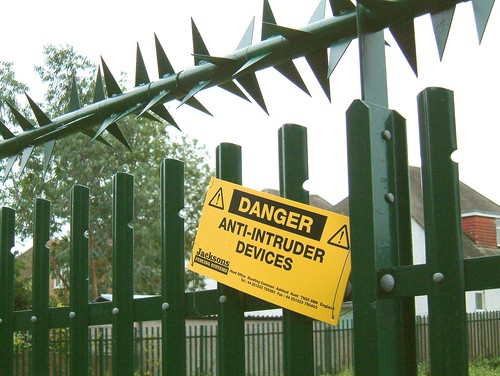
The photo above is of a fence around our local scout hut, which was burned down twice. And when they rebuilt it, it was quickly covered in graffiti. They've resorted to surrounding it with evil-looking spikes and a tall fence. Right next to it is a playground that used to be constantly covered in broken glass and the remains of equipment that the local yobs had been diligently trying to smash into smithereens for years. Frequent visits from the police did nothing. The solution was to put in new equipment. People started to bring their kids again, and the vandalism declined dramatically.

The same effect can be seen on the Internet, where the equivalent of the vandals are the spammers, script kiddies and phishers who have turned some previously valuable corners of the Web into neighborhoods you'd hesitate to walk through at night. But spammers are a minority, by a long shot. Most people are good. The more of the latter who use the Internet -- really use it, by contributing to it, not just consuming what the big media companies give you -- the more hospitable, interesting, pleasant and valuable place it becomes.

Tags: , ,

Encouraging File Sharing for Cash

Revver is one of the most interesting attempts to make a business out of file sharing. Video creators upload their files, the company adds an advertisement, and then splits the resulting ad revenue with the creator. The files can be distributed everywhere, using whatever software, because the ads are embedded in the file itself. I spotted one today that was wonderful -- a video of a guy getting some amazing sounds out of a ukulele. Unfortunately, it's gone now.

A couple of problems: First, if the ads just measure views and not clicks, it could be considered spyware. There should be an option to just purchase the video, sans ads. The second problem is that I don't know how the ads work. I'm using Linux, and the only viewer I have for quicktime videos doesn't show me the advertisements. So, on Linux at least, I can't show my appreciation by at least clicking on something. Perhaps Revver should offer filmmakers the option to convert their videos into some more standard formats, or even flash, like YouTube does?

(Updated: The video I was pointing to has disappeared. Bummer.)


Tags: , ,